No one shows up to a toolbox talk excited. That’s the reality. Workers see them as routine, repetitive, even irrelevant—especially when the content feels canned or disconnected from daily risks. But when done right, a weekly safety toolbox talk isn’t just compliance. It’s a lifeline. It stops injuries before they happen, reinforces safety culture, and gives teams a shared language for risk.
The problem? Most organizations recycle the same three topics—hard hats, gloves, and “be careful.” That’s not engagement. That’s check-the-box fatigue.
To cut through the noise, your weekly safety toolbox talk topics must be timely, specific, and rooted in real operations. They need to reflect actual site conditions, emerging hazards, and team feedback. This article delivers practical, high-impact topics with examples, implementation tips, and common mistakes to avoid—so your weekly talks finally matter.
Why Most Weekly Safety Toolbox Talks Fail
Toolbox talks fail not because the concept is flawed, but because execution is lazy. Generic advice like “stay alert” or “wear PPE” doesn’t land because it’s not tied to context. Workers need to know why a rule exists and how it applies today.
Common pitfalls: - Overused topics: Ladder safety every quarter doesn’t help if your crew is doing overhead welding. - No follow-up: Talks end with no action items or accountability. - One-size-fits-all: Office supervisors deliver talks without site-specific input. - Zero engagement: No questions, no discussion—just a monologue.
A successful weekly toolbox talk addresses a specific hazard this week, involves the team, and ends with a clear takeaway. It’s not a lecture. It’s a safety huddle.
Top 10 Weekly Safety Toolbox Talk Topics (With Real Examples)
These topics go beyond basics. They’re designed for relevance, discussion, and real behavioral change.
#### 1. Job-Specific Hazard Recognition
Instead of “watch for hazards,” focus on what’s changing this week. For example: “We’re starting excavation near underground utilities—what are the top 3 risks?”
Use case: A construction crew begins trenching. The talk covers: - Call-before-you-dig procedures - Soil classification signs (cracks, water seepage) - Emergency exit requirements every 25 feet
Tip: Have workers point to hazards on site during the talk. Active participation increases retention.
#### 2. Near-Miss Reporting: Why Silence Is Dangerous
Most injuries are preceded by near misses. Yet, many workers don’t report them—fearing blame or paperwork.
Example: A loader operator almost hit a spotter. No one was hurt. But the incident wasn’t reported. A week later, a similar setup causes a collision.
Talk focus: - Normalize near-miss reporting - Share an anonymous real example - Walk through the reporting process in 60 seconds
Outcome: Reduce fear, increase transparency.
#### 3. Proper Use of Fall Protection at Height
Not all fall protection is equal. A harness is useless if anchored incorrectly.
Discussion points: - Anchor point strength (5,000 lbs minimum) - Lanyard shock absorption - Trip hazards while connected
Activity: Rotate crew members to inspect each other’s harness setup. Peer review catches more errors.
#### 4. Heat Stress Awareness (Even in Mild Climates)
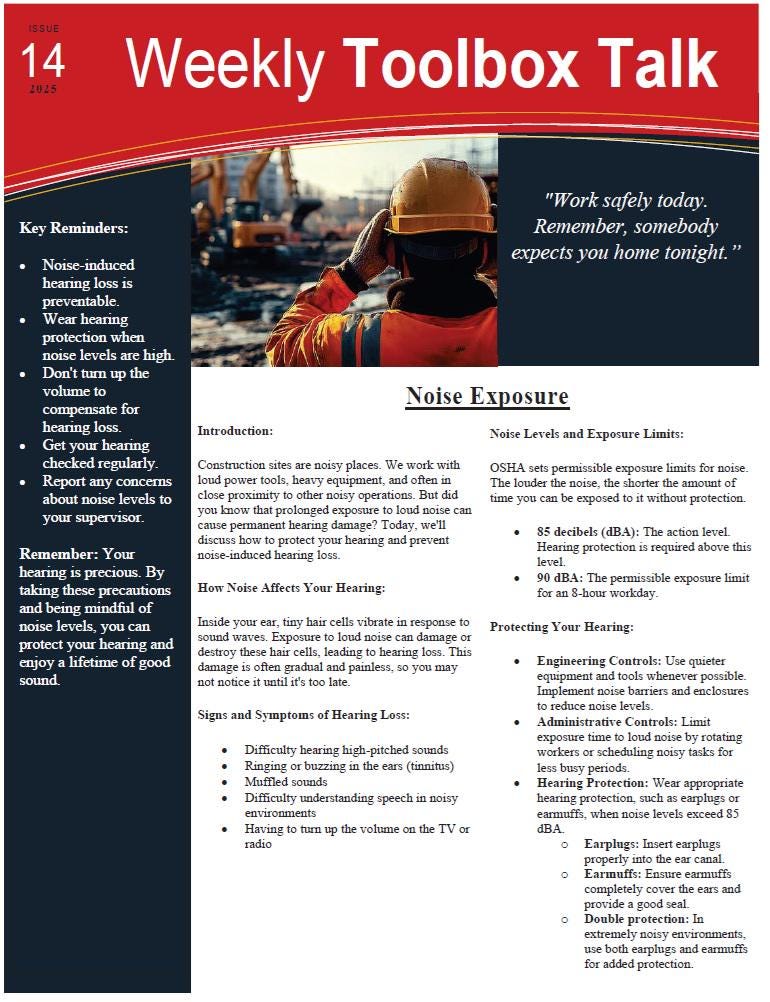
Heat illness isn’t just a summer-in-Arizona issue. Enclosed spaces, PPE, and physical exertion compound risk.
Real scenario: A technician in a boiler room wears flame-resistant gear. After two hours, he feels dizzy. No one notices until he staggers.
Talk elements: - Early signs: headache, nausea, cramps - Hydration rules (sip every 15–20 mins) - Buddy system checks
Pro tip: Schedule high-exertion tasks for cooler hours.
#### 5. Electrical Safety During Equipment Maintenance
Lockout/Tagout (LOTO) failures cause hundreds of injuries yearly. Often, it’s due to complacency.
Case: A mechanic bypasses LOTO because “it’ll just take a minute.” Machine powers on unexpectedly.
Talk structure: - Review LOTO steps - Show a photo from a real incident (without identifying details) - Ask: “Where have you seen shortcuts taken?”
Goal: Reinforce that any maintenance requires full isolation.
#### 6. Manual Handling: It’s Not Just About Lifting
Most think “lift with your legs.” But awkward postures, repetitive motion, and carrying objects obstructing vision are equally dangerous.
Example: A worker carries a long HVAC duct down a stairwell. Can’t see steps. Trips.
Discussion: - Use dollies or team lifts - Clear walking paths - Recognize cumulative strain
Action: Demonstrate proper team-lift communication cues.
#### 7. Mental Fatigue and Focus on the Job
Fatigue isn’t just physical. Long shifts, personal stress, and shift work impair judgment.
Data point: Workers are 60% more likely to be injured during the last two hours of a 12-hour shift.
Talk approach: - Ask: “Who felt too tired to focus yesterday?” (Anonymous poll) - Discuss signs of mental fatigue: slow reaction, forgetfulness - Encourage speaking up when overwhelmed
Key message: Safety includes mental readiness.
#### 8. Confined Space Entry Protocol
Even experienced crews skip steps—like testing atmosphere after entry.
Example: A worker enters a tank, tests air, and finds low oxygen. Too late.
Talk focus: - Test before entry, every time - Attendant must remain outside - Rescue plan must be site-specific
Drill: Run a 2-minute verbal walkthrough of entry steps.
#### 9. Slips, Trips, and Falls on Same Level
These cause more lost-time injuries than falls from height.
Common causes: - Wet floors after cleaning - Cords across walkways - Cluttered toolboxes
Prevention: - “Clean as you go” rule - Floor marking for high-traffic zones - Non-slip footwear check
Engagement: Have crew audit a work zone for trip hazards.
#### 10. Emergency Response Readiness
Everyone knows where the first aid kit is. But can they use it?
Practice talk: - Review location of AEDs, eyewash stations, fire extinguishers - Conduct a 60-second “what if” drill: “What if someone collapses here?” - Assign roles: caller, first aider, evacuator
Outcome: Build muscle memory for emergencies.
How to Structure a High-Impact Toolbox Talk
A good talk takes 10–15 minutes. Follow this flow:
- Hook (1 min): Start with a real incident or observation.
- “Yesterday, I saw a ladder leaning on a gutter. That’s a tip hazard.”
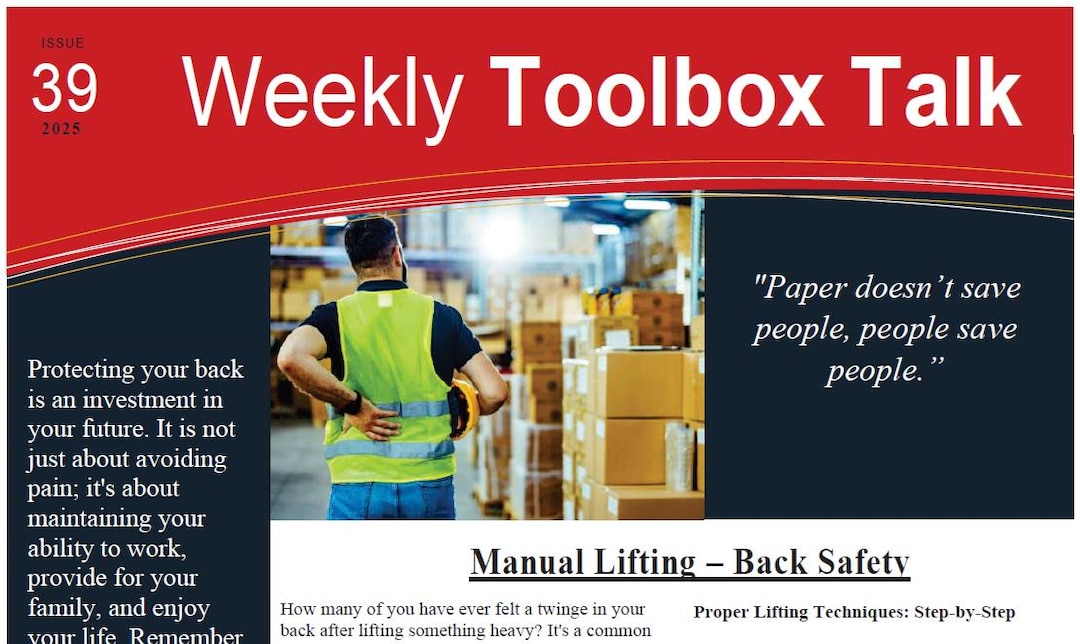
- Hazard Breakdown (5 min): Explain what can go wrong, why, and how often. Use photos or props.
- Discussion (5 min): Ask open questions.
- “What’s the safest way to secure a ladder on soft ground?”
- Action Step (2 min): Assign one behavior change.
- “This week, every ladder setup must be inspected by a second person.”
- Sign-Off: Record attendance, circulate notes, post key points.
Common Mistakes to Avoid
- Reading from a script: Workers tune out. Speak naturally.
- Ignoring feedback: If the same issue keeps coming up, address it.
- No documentation: Without records, you can’t track progress or prove compliance.
- Only focusing on individuals: Sometimes the hazard is a broken process, not a careless worker.
Pro insight: Rotate talk leaders. When workers lead, engagement spikes.
How to Keep Topics Fresh and Relevant
Rotate through a 12-week safety cycle. Example:
| Week | Topic | Trigger |
|---|---|---|
| 1 | Ladder Safety | Spring maintenance begins |
| 2 | Eye Protection | Grinding work scheduled |
| 3 | Noise Exposure | Jackhammer use starts |
| 4 | Fire Extinguisher Use | Hot work permit issued |
| 5 | Scaffold Inspection | New level being built |
| 6 | Chemical Handling | Paint contractor on site |
Use near-miss reports, audit findings, and weather changes to adjust topics weekly.
Tools to Plan and Deliver Better Talks
While no tool replaces skilled facilitation, these help organize content and track participation:
- SafetyCulture (iAuditor)
- - Pros: Mobile-friendly, pre-built templates, photo evidence, auto-reporting
- - Best for: Teams needing digital records and real-time analytics
- SiteDocs
- - Pros: Custom forms, offline access, integration with ERP systems
- - Best for: Large construction or industrial operations
- SafeSite FX
- - Pros: Automated reminders, OSHA-compliant topics, attendance tracking
- - Best for: Contractors managing multiple crews
- FL00R
- - Pros: Visual checklists, simple UI, quick deployment
- - Best for: Small to mid-sized teams wanting ease of use
- Penspen Toolbox Talk Manager
- - Pros: Industry-specific content, multilingual support, audit-ready logs
- - Best for: Oil & gas, energy, and high-risk sectors
No tool is perfect—choose based on your team size, tech access, and reporting needs.
Weekly safety toolbox talks don’t have to be dull or ineffective. The difference between check-the-box and life-saving lies in relevance, delivery, and follow-through. Pick a real hazard. Talk about it with your team. Assign one action. Repeat.
Start next week with a topic tied to what’s actually happening on site. Make it specific. Make it interactive. Make it matter.
FAQ
What should be included in a weekly safety toolbox talk? A clear hazard focus, real-world example, team discussion, and one actionable safety behavior.
How long should a toolbox talk last? 10 to 15 minutes—long enough to engage, short enough to respect time.
Who should lead the talk? Supervisors, but rotate to include experienced workers for broader perspective.
How often should toolbox talks be held? Weekly is standard, but increase frequency during high-risk operations.
Should toolbox talks be documented? Yes—record attendance, topic, and key points for compliance and tracking.
Can toolbox talks reduce workplace injuries? Yes, when they’re relevant, interactive, and tied to real site conditions.
Are toolbox talks required by OSHA? Not explicitly, but OSHA requires hazard communication and training—toolbox talks are a recognized method.
FAQ
What should you look for in Weekly Safety Toolbox Talk Topics That Actually Work? Focus on relevance, practical value, and how well the solution matches real user intent.
Is Weekly Safety Toolbox Talk Topics That Actually Work suitable for beginners? That depends on the workflow, but a clear step-by-step approach usually makes it easier to start.
How do you compare options around Weekly Safety Toolbox Talk Topics That Actually Work? Compare features, trust signals, limitations, pricing, and ease of implementation.
What mistakes should you avoid? Avoid generic choices, weak validation, and decisions based only on marketing claims.
What is the next best step? Shortlist the most relevant options, validate them quickly, and refine from real-world results.

:max_bytes(150000):strip_icc()/GettyImages-21696356521-4fbe8ad077b44dd89725c2f789cb6716.jpg)